Thursday, November 4, 2010

Blog Prompt Reply #21

In what ways do you "construct" your identity? In what ways do your "perform" in your daily life?
I would say that people construct their identity through physical actions. For example, when we get up in the morning and get dressed and put our makeup on, we are "constructing" our identity. Kind of like getting ready to be a character for Halloween or for a play. We then "perform" our identity through our actions and how we act throughout the day. I guess this is if you think of an identity as your character or your personality. I personally perform by striving to be a hard worker and be successful. I have really struggled lately and almost feel swamped by the pile of work I have, but I am a hard worker and keep chugging through.

Describe some ways in which your personal culture and social environments are "constructed".
My personal culture is constructed through the people and places around me. My personal culture is constructed by the food I eat, the people I surround myself with, the places I go, the music I listen to and so on. I would say that trends have a huge role in my culture and social environments. My family is another sense of construction in my life, because they have given me the "building blocks" that I feel are necessary for life, whether it be life skills, morals or work ethics, they have helped construct who I am both personally and socially.

Describe some ways in which your physical environment/space is "constructed"?
Some way in which my physical environment are constructed are through a little bit of chaos actually. With my life being as hectic as it is, my physical environment can get very cluttered and organized. For example, my car and my bedroom become quite "chaotic" this time of year and as a result, construct a very stressful environment for my identity. Vicious circle I guess. :)

In your daily life, what would you consider to be "real" and what would you consider to be "constructed/fabricated"?
First thing that popped into my head as real is love. The love I feel for my family and for my boyfriend are every bit of real. I feel like the hustle and bustle of life and the go go go schedules that we all have are kind of constructed in a way. We choose what car we drive, what job we have, what clothes we where, but when you come home at the end of the day, and feel that love, you know it's real and meant to be there. Although you have control of love, you definitely don't have to think about it as much. Another example, kind of funny, but I think of people's "phone voices" as constructed. Everyone has  their nice voice on when they answer the phone and it is so funny to hear how people act so sweet on the phone and then get off and be their "real" selves.

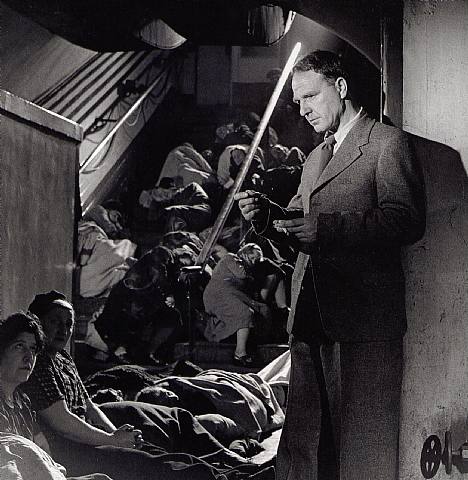
Constructed Realities: Artist Research

"Henry Moore, London 1943" by Lee Miller


This is the image that was assigned to me to research for constructed realities. This photo was taken in an underground station in Holborn. There is a very dramatic use of light in this photo that falls on the main subjects face as well as from the top of the stairwell to really illuminate the subjects in the background as well. This dramatic use of light really adds to the depth and texture of the drapery in the photo. Henry Moore was a wartime artist at this time and is pictured here with many people seated and sleeping behind him, perhaps taking cover from war? I just find it interesting as to why everyone is there and he is just standing in a suit, with such a somber look on his face. Very different. Almost looks like a scene from a film to me.


Another artist I was assigned to research was Barbara Kasten. After viewing some of her work, I decided that her style is very abstract and almost open to interpretation. It appears that she is working with cut pieces of glass to create very linear and pointed pieces. These could be considered a constructed reality because they are so different and almost computer generated feeling because of the amount of plains and points. As a viewer, we aren't quite sure what it is, but it is very interesting to analyze and you almost get lost in the different gray tones.


Thomas Demand was the other artist that I researched and his work was really interesting to me because the photographs of different rooms that he makes are actually cardboard minis that he photographs as if they are a real room. When I first looked at his images, I had no idea that they were fake. At first they appear to have a little bit of a "too perfect" quality to them, but then after I realized that they were fake little sets, it all made sense. Very interesting and possibly an idea I may try for my project. Maybe shoot a dollhouse or something similar.

Sunday, October 31, 2010

Blog Prompt #20 Reply

“We therefore consume images fleetingly and randomly. It takes very special pictures to grasp and hold our attention. We need to be seduced by images that outdo reality through excessiveness—as in advertising and movies” (Constructed Realities: The Art of Staged Photography Edited by Michael Kohler). What do you think about this quote? How do you think that our lives are changing as the speed of our interaction with photographic images grows?

I agree with this quote because photography is becoming so much more common, that we must rely on GREAT photography to really wow the viewers. It is sort of scary to me as a photographer that just anyone can go get a pretty decent digital SLR for less than $500 and then suddenly think that they are a photographer, but as this quote says, the photos must seduce us and "outdo reality" of regular photography. Our lives will be more effected by this, because it will be much harder to sort through the quantity in order to find the "quality".


“But the term ‘Infotainment’ also implies this: with the gradual fictionalization of even the news, the old categorical oppositions of ‘documenting’ and ‘staging’, appearance and reality gradually dissolve. They are being replaced by a variety of hybrid forms for which it will be impossible, in fact pointless, to attempt to distinguish between fact and fiction. Even the accusation that ‘Infotainment’ is guilty of continuous ‘lying’ is therefore unjustified, for it is neither ‘true’ nor ‘false’. Like advertising, movies and all other genres that adhere to the laws of fiction, it works at a level beyond these oppositions—the level of ‘hyper-reality’, where reality is ‘simulated’.” (Constructed Realities: The Art of Staged PhotographyEdited by Michael Kohler). What are your thoughts on “Infotainment” and how it affects our lives? How does it affect the way we see and understand “reality”? How does it affect photography in general?

I have mixed emotions about this. I really LOVE the opportunity that photoshop holds and what it can do to photos, but I also feel that it has really changed the art part of "photography". If anything now, photography is becoming more of a mixed or hybrid form as mentioned above. I just think that it is crazy that people rely on photography as affirmations of certain buzz and news stories, even knowing how much computers can alter images and skew the truth behind them. That is like taking evidence statements at a crime scene from somebody that you know is completely capable of lying. This type of photography and "infotainment", by no means needs to stop, people just need to know that it should be taken more as a grain of salt.

Sunday, October 24, 2010

Blog Prompt #19 Reply

I can't really think of anything that shouldn't be photographed. Obviously there are SOME things that shouldn't be if they are extremely illegal or looked down upon by the general public, but other than that, it seems like all things are a go because photography is such a free spirited art.


It's hard to think of things that cannot be photographed, but the only thing that I can think of is emotion. Yes we can CONVEY emotion through our photographs, but we will never know for sure what that person is feeling inside. Emotions run much deeper than our physical shell.


Something I would never care to photograph in my life is death. I think about how awful it would have to be to be a crime scene photographer and to have to document human deaths and blood splatter and so on. I just think it would pull me in way too much and make it personal because of the fact that those poor victims are fellow human beings and I just wouldn't be able to emotionally handle it!

Tuesday, October 19, 2010

Tom Friedman

The artist that I chose to research was Tom Friedman. The website that I found with information about him said that self-portraits make up a lot of his work, yet when I looked at the photo I didn't see the "self-portrait" anywhere. As I read a little further I realized that he does these in a very skewed and abstract way. I read that he actually uses a flat-bed scanner and drags the image while the scan is taking place to make these really abstract photos. This gives it a really abstract, dynamic, and almost landscape look to his work. "If one looks closely, Friedman's hair, belt, and shoes are visible as horizontal bands, almost like an abstracted landscape".

www.cartincollection.com/subject/friedman.html

Untitled, 1998 by Tom Friedman

Sunday, October 17, 2010

Blog Prompt #16, #17, #18


“I believe in the imagination. What I cannot see is infinitely more important than what I can see.” Duane Michals

Only because I had a GREAT imagination when I was little!!! I am a FIRM believer in having a great imagination. That is what makes verbal stories great as you picture them in your head, imagining what-ifs, and all that good stuff. There is a reason that we were given the ability to imagine and I think it is important to exercise that. Could you imagine how boring life would be without imagination? Ick.

“Landscape photography is the supreme test of the photographer—and often the supreme disappointment.” ~Ansel Adams

Totally agree! Especially when I think of Ansel Adams' work and how amazing it is. It seems like nothing else could compare. It seems like as a photographer, everywhere you look, your mind is appreciating nature's beauty and wondering how it could be photographed. Then, you get this ideal photo in your mind and the hardest part is making it happen, if it is even possible. Then, after you photograph it, there is a large chance that it won't look half as good as what you pictured in your mind.


“Photography can only represent the present. Once photographed, the subject becomes part of the past.” Berenice Abbott

I sort of agree with this statement, because I can no way picture taking a photograph of the past or future. I guess I think of photography to technically sometimes and especially when thinking about this quote because I just picture a photo being taken at that moment. The minute you take a photo, it begins to become the past because that moment in time has already passed.